Quote:
Benchmarks range wildly here, from Scaleway’s performance being “only somewhat worse than DigitalOcean” to “much worse” to “catastrophic”.
Source:
https://blog.rebased.pl/2015/11/04/scaleway-vs-digitalocean.html
Quote:
Benchmarks range wildly here, from Scaleway’s performance being “only somewhat worse than DigitalOcean” to “much worse” to “catastrophic”.
Source:
https://blog.rebased.pl/2015/11/04/scaleway-vs-digitalocean.html
This interesting article from DZone explores why in some cases microservices actually become a burden and reverting back to monolith instead can be the solution.
In early 2017, we reached a tipping point with a core piece of Segment’s product. It seemed as if we were falling from the microservices tree, hitting every branch on the way down. Instead of enabling us to move faster, the small team found themselves mired in exploding complexity. Essential benefits of this architecture became burdens. As our velocity plummeted, our defect rate exploded.
Eventually, the team found themselves unable to make headway, with 3 full-time engineers spending most of their time just keeping the system alive. Something had to change. This post is the story of how we took a step back and embraced an approach that aligned well with our product requirements and needs of the team.
Goodbye Microservices: From Hundreds of Problem Children to One Superstar
James Higginbotham describes nine things to consider when you decide to run docker in production servers.
Developers need to remember that Docker is a tool, not a full-blown cloud native architecture solution. It offers some amazing capabilities, and I’m very happy to have Docker as part of my architecture. But it requires the same effort to maintain a production Docker deployment as any other cloud-based solution (and perhaps even more).
Read more here.
DNS Bersama APJII: http://dns.apjii.or.id
IP1: 203.119.13.77
IP2: 203.118.13.78
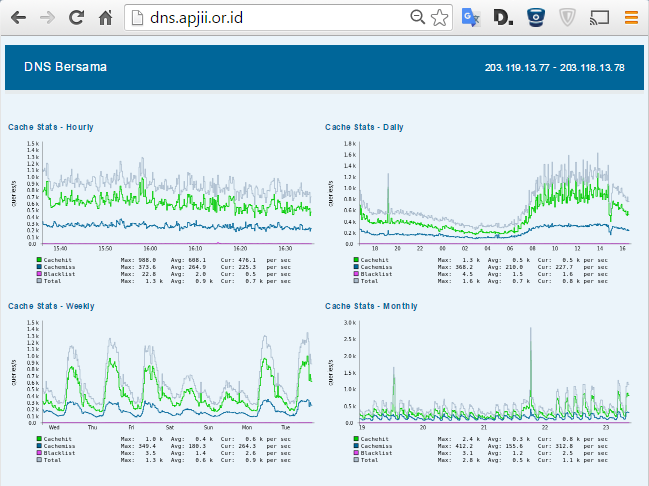
UPDATE: this DNS already shut down due to some internal circumstances. Sorry ¯\_(ツ)_/¯
UPDATE Nov 12: it’s alive! alive!
UPDATE 20180530: FB DNS ꦨꦼꦂꦱꦩ
Oracle Promises 100x Faster DB Queries With New In-Memory Option
Posted by timothy on Monday September 23, 2013 @06:00AM
from the now-report-back-on-the-double dept.
Hugh Pickens DOT Com writes"ZDNet reports that Oracle’s Larry Elison kicked off Oracle OpenWorld 2013 promising a 100x speed-up querying OTLP database or data warehouse batches by means of a ‘dual format’ for both row and column in-memory formats for the same data and table. Using Oracle’s ‘dual-format in-memory database’ option, every transaction is recorded in row format simultaneously with writing the same data into a columnar database. ‘This is pure in-memory columnar technology,’ said Ellison, explaining that means no logging and very little overhead on data changes while the CPU core scans local in-memory columns. Ellison followed up with the introduction of Oracle’s new M6-32 ‘Big Memory Machine,’ touted to be the fastest in-memory machine in the world, hosting 32 terabytes of DRAM memory and up to 384 processor cores with 8-threads per core."
# ss -n |grep ESTAB |wc -l

13615
# ss -n |grep CLOSE-WAIT |wc -l

10832
# ss -n |grep FIN-WAIT |wc -l

1976
# ss -V

ss utility, iproute2-ss061002
serverframework.com has written an interesting article about how the TIME_WAIT state really works. The link will get you there:
check for yourself right here:
This entry is for those people who have ever wondered, “Why the hell is a simple KDE text editor taking up 25 megabytes of memory?” Many people are led to believe that many Linux applications, especially KDE or Gnome programs, are “bloated” based solely upon what tools like ps report. While this may or may not be true, depending on the program, it is not generally true — many programs are much more memory efficient than they seem.
Read the complete article on virtualthreads
 ivo's home