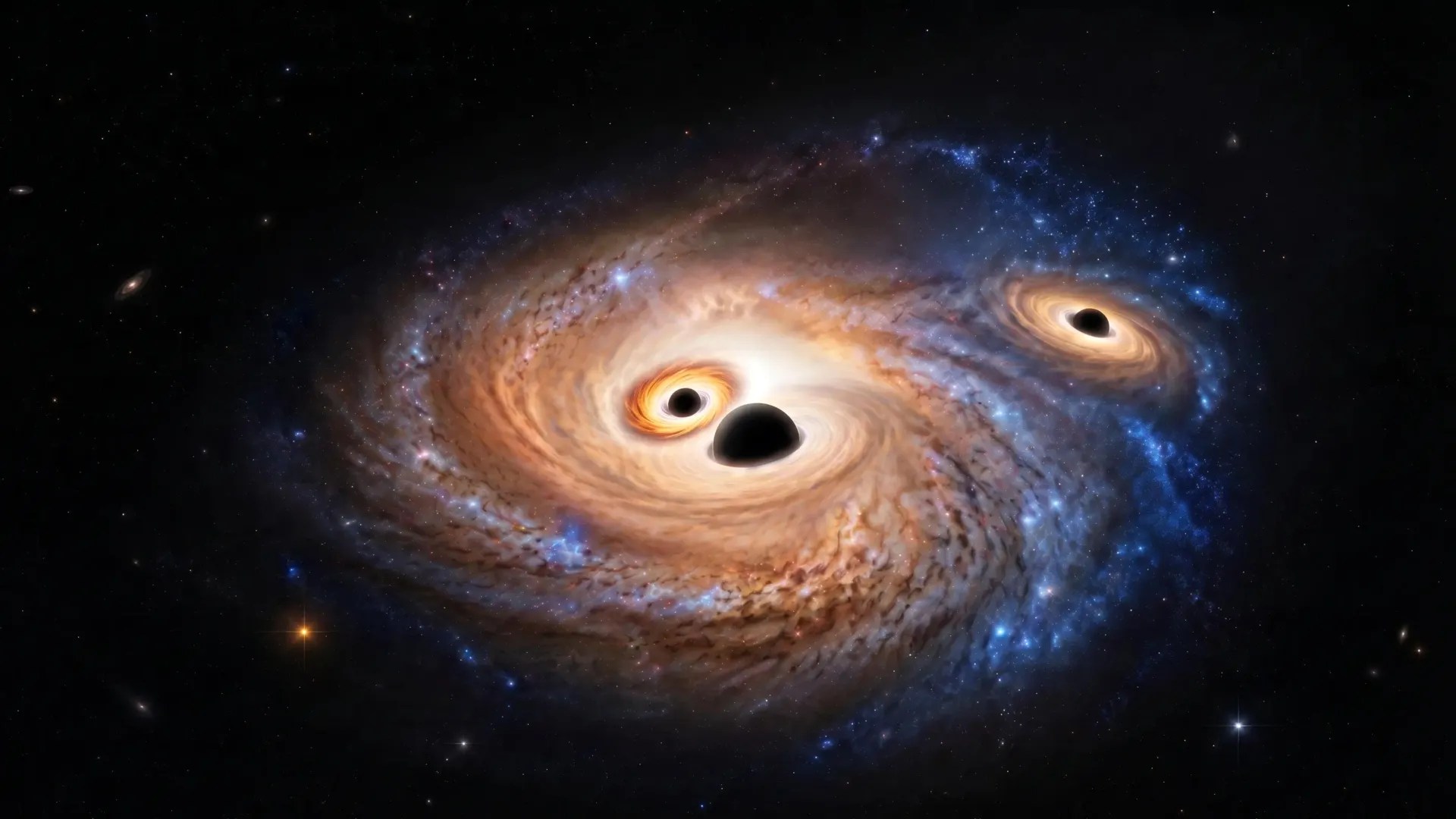
Astronomers using the James Webb Space Telescope have identified three active supermassive black holes packed into a single galaxy seen as it existed 1.2 billion years after the Big Bang. Two of the objects sit near the center separated by just 620 light-years, while the third orbits roughly 5,500 light-years away. By analyzing hydrogen emission patterns through spectro-astrometry, researchers determined their masses range from 600,000 to 80 million solar masses.
This clustering suggests that early galaxy collisions efficiently herded massive black holes together, offering a mechanism to explain how cosmic giants grew so quickly in the young universe. One of the smaller black holes is currently accumulating matter faster than standard growth models predict, pointing to gaps in our understanding of accretion limits. While the central pair will likely merge within a few hundred million years, how the third ended up so far off-center remains an open question.
more: https://www.sciencedaily.com/releases/2026/10/261024222000.htm
my other side: ivo.blogspot.com


Leave a Reply