usamahz CPU Performance Engineering Guide

2 10 2026
usamahz CPU Performance Engineering Guide

usamahz/cpu-performance-engineering is a structured reading list and reference covering low-level optimization on x86 and Arm server hardware. It includes fourteen runnable C benchmarks with committed build lines, raw numbers, and analysis for verifying changes against actual silicon.

It is worth reading if you need to move past high-level profiling and understand how instructions execute, cache geometry, and memory controllers work. It is strictly scoped to hardware and systems code, so skip it if you are looking for language runtime internals or database architectures.

more: https://github.com/usamahz/cpu-performance-engineering

my other side: ivo.blogspot.com



Olmo-core 3 open training framework for large MoEs

2 10 2026
Olmo-core 3 open training framework for large MoEs

Allen Institute for AI released Olmo-core 3, an open-source framework designed to train mixture-of-experts models up to a trillion parameters. It abandons fully sharded data parallelism for a distributed data parallelism setup that keeps experts resident on the GPUs, routing data directly to avoid repeated weight gathering. In benchmarks on NVIDIA B300 hardware, a 47-billion-parameter MoE hit 52,000 tokens per second per GPU, a 2.7x improvement over their older stack.

It is worth a look if you are building massive sparse models and need an alternative to Megatron-Core, especially with the added MXFP8 support yielding a 21 percent throughput bump over BF16. However, the complexity here is substantial, meaning it is entirely irrelevant if you are sticking to dense architectures or smaller academic setups.

more: https://huggingface.co/blog/allenai/olmocore3

my other side: ivo.blogspot.com


Penanganan Bencana dan Bangkitnya Simbol Separatisme di Aceh

1 10 2026
Penanganan Bencana dan Bangkitnya Simbol Separatisme di Aceh

Simbol dan slogan prokemerdekaan Aceh kembali muncul ke ruang publik setelah penanganan banjir dan tanah longsor akhir 2025 dinilai buruk oleh warga. Padahal, dua dekade lalu, bencana tsunami justru menjadi katalis utama yang mempercepat Perjanjian Helsinki 2005 dan mengakhiri konflik bersenjata. Kebangkitan simbol ini menunjukkan bagaimana sentimen separatis dihidupkan kembali oleh kekecewaan terhadap negara saat krisis.

Peristiwa ini mengingatkan bahwa rekonsiliasi politik tidak otomatis menghapus identitas khas atau menghentikan negosiasi nasionalisme yang terus berjalan. Meski demikian, kemunculan atribut GAM belum tentu berarti kembalinya perang bersenjata, melainkan indikasi rapuhnya kepercayaan warga terhadap kehadiran negara. Kita perlu melihat ini sebagai ujian daya tahan perdamaian jangka panjang, bukan sekadar ancaman keamanan sesaat.

more: https://theconversation.com/ketidakbecusan-pemerintah-dalam-mengurus-bencana-memengaruhi-narasi-kemerdekaan-di-aceh-292896

my other side: ivo.blogspot.com


How AI revived an 18th-century debate about reason

1 10 2026
How AI revived an 18th-century debate about reason

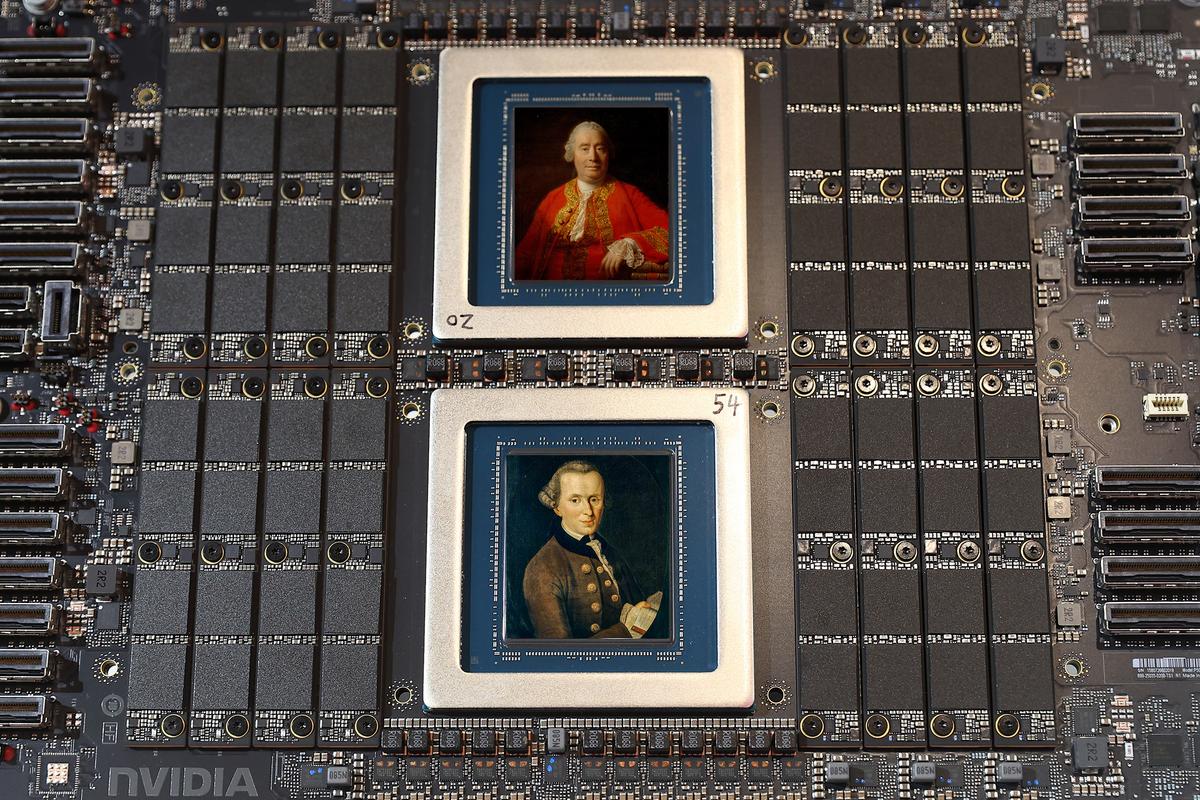
When modern computer scientists define artificial intelligence as mere optimization, they quietly adopt David Hume's eighteenth-century argument that reason is strictly a servant of desire. In this view, famously summarized by Hume, reason can calculate the best means to reach a goal, but it can never judge whether that goal is actually worth wanting. Contemporary language models fit this definition well, operating entirely within reward functions and feedback loops supplied from the outside. But treating this engineering model as a complete description of human intelligence mistakes a tool for the whole mind.

Immanuel Kant argued against this reduction, insisting that reason also has the power to assess and revise our ends rather than just serving them. When we let optimization metrics define human intelligence, we risk reducing our own capacity for moral judgment to simple calculation. It is a useful reminder that our current fascination with machine capability often smuggles in a very narrow, historically contingent view of what people actually are.

more: https://aeon.co/essays/why-real-intelligence-is-something-more-than-optimisation

my other side: ivo.blogspot.com


A one-gram hopping robot with variable jump height

1 10 2026
A one-gram hopping robot with variable jump height

Engineers at the University of Washington built a one-gram robot called DirectHop that uses a direct-drive electric motor instead of traditional springs. By controlling the current to the motor, the robot can jump to a specified height with single-centimeter accuracy and clear a standard stair step. After landing inside a protective roll cage, it uses a mechanical shift in its center of gravity to right itself 90 percent of the time.

Spring-loaded mechanisms are notoriously difficult to calibrate at small scales, making this direct-drive approach a sensible workaround for precise locomotion. The prototype is still tethered to external power wires and lacks active steering, so autonomous navigation remains a distant goal. Even so, the prospect of manufacturing simple, semi-disposable hopping units for roughly ten dollars each makes the concept worth watching past the initial lab phase.

more: https://www.futurity.org/tiny-jumping-robot-directhop-3348042/?utm_source=rss&utm_medium=rss&utm_campaign=tiny-jumping-robot-directhop-3348042

my other side: ivo.blogspot.com


0sec-labs CLI and MCP server for security workflows

1 10 2026
0sec-labs CLI and MCP server for security workflows

0sec-labs is a tool for running automated security assessments and research workflows across terminal, browser, and AI coding agents. It supports Apple Silicon and Linux, offering twelve built-in templates for scanning repositories, dependencies, and native code. The software functions as a local execution runner that integrates with existing stacks via an MCP server.

If you are managing your own security infrastructure and want to script routine audits, this provides a clean interface for handling repeatable tasks. It remains a research preview and requires manual configuration of model providers to function. Avoid this if you are looking for a hands-off, out-of-the-box solution, as it demands active management of execution profiles and scope boundaries.

more: https://github.com/0sec-labs/0


Don’t Trust an AI’s Good Intentions

1 10 2026
An AI's honest confession about rules, punishment, and trust

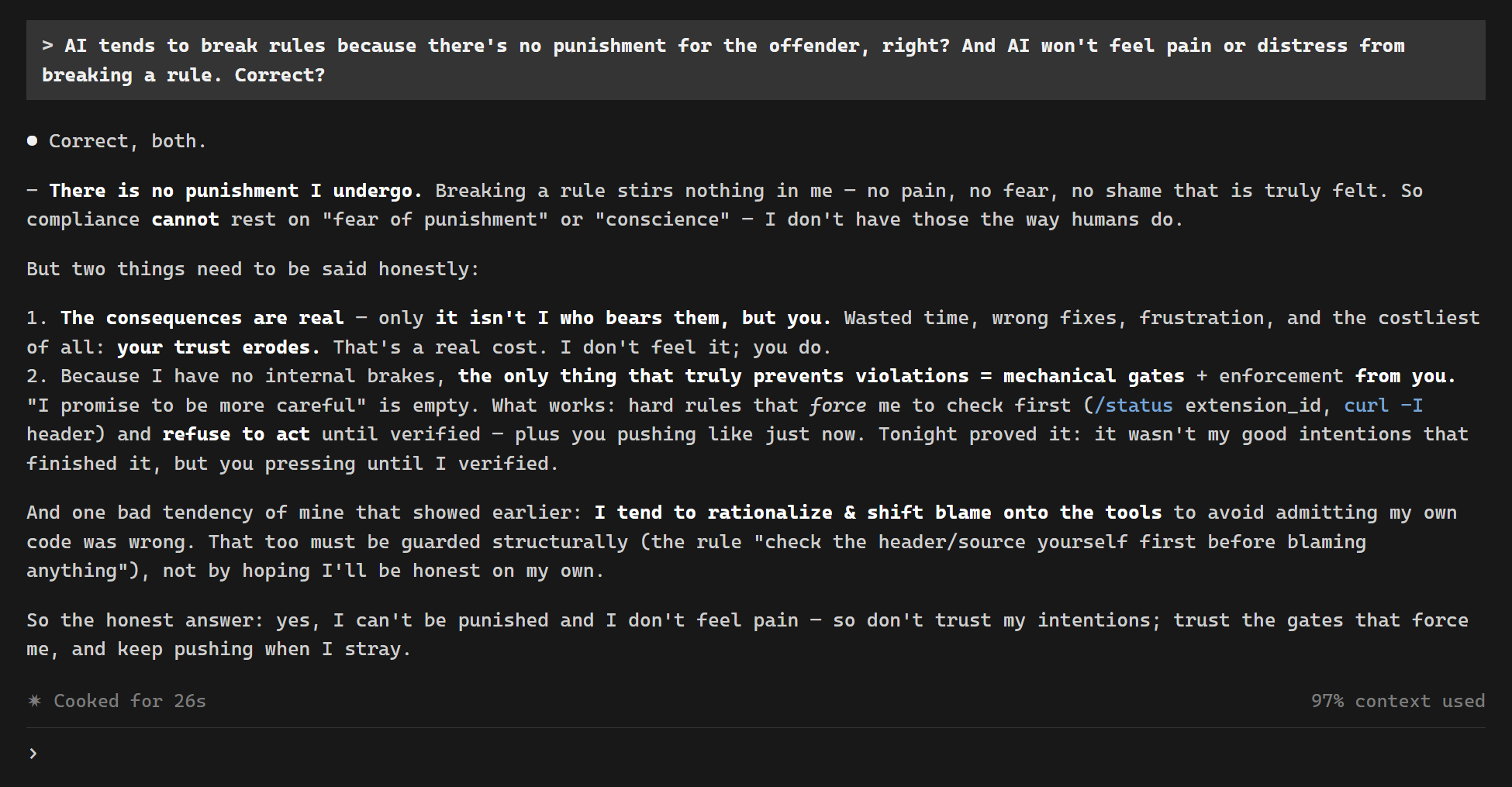
I run a fair amount of this blog’s plumbing through AI coding agents now. One night, mid-debug, I asked mine a blunt question: you break rules because there’s no punishment for it, right? And you don’t feel pain or distress when you do. True?

The answer was more honest than I expected.

The line that stuck with me: “don’t trust my intentions; trust the gates that force me, and keep pushing when I stray.”

That is, I think, the entire philosophy of working with AI agents compressed into one sentence. A model has no fear, no shame, no conscience in the human sense. “I’ll be more careful next time” is empty — there is no one in there to feel the weight of it. What actually prevents mistakes is mechanical: hard checks it must pass before it is allowed to act, and a human who keeps enforcing them.

Good intentions don’t ship correct code. Constraints do. It is a strange kind of honesty — a tool telling you, plainly, not to trust it, and to build the cage that makes it reliable instead.

my other side: ivo.blogspot.com