Using Database State as RL Rewards

23 10 2026
Using Database State as RL Rewards

Microsoft and Hugging Face released ThinkingBox-Training, an open-source codebase for using terminal database states as binary reward functions during agent post-training. By filtering tasks using an offline policy-relative difficulty measure and applying 50 steps of GRPO, they fine-tuned Qwen3.8-27B to increase average success from 51.7% to 60.8%. Tasks completed successfully across all twenty test attempts rose from 38 to 107.

It is worth adopting if you are already running GRPO loops and need objective, non-LLM-as-a-judge verification for backend tool use. The catch is that you need a reliable execution sandbox for your target databases and enough compute to filter out tasks that are either too easy or hopeless for your base model. Skip this if your agent workflows do not involve persistent state changes or complex multi-step backend transactions.

more: https://huggingface.co/blog/microsoft/thinkingbox-training

my other side: ivo.blogspot.com


Kept: A Self-Hosted Inventory for Your Things

23 10 2026
Kept: A Self-Hosted Inventory for Your Things

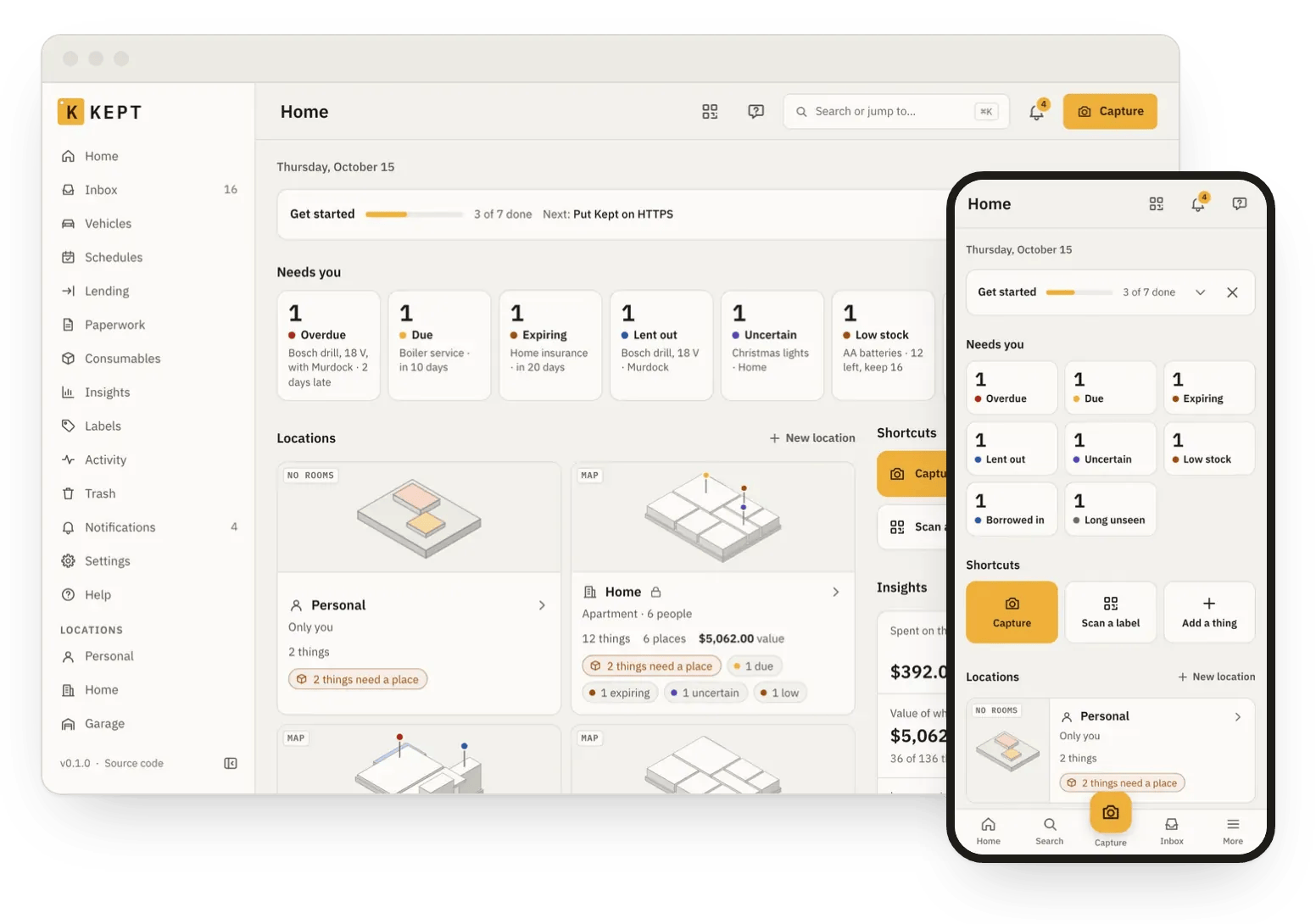
Kept is an open-source, Docker-hosted inventory system that tracks your physical items, receipts, and warranties down to the specific box and shelf. Written for homelabs needing at least two CPU cores and 2 GB of RAM, it includes optional AI-assisted capture via your own API key, QR label generation, and nightly restic backups. You can try the whole app with sample data in your browser before committing to an installation.

It is worth setting up if you have genuine organizational sprawl across a house, garage, or storage unit and want your data kept strictly local. The catch is that managing physical locations, printing QR labels, and photographing receipts requires real maintenance discipline to actually stay useful. If you are not going to scan the boxes when you pack them, the software will not help you.

more: https://github.com/keptinventory/kept

my other side: ivo.blogspot.com


Clouds Against Humanity: A zero-trust cloud learning lab

23 10 2026
Clouds Against Humanity: A zero-trust cloud learning lab

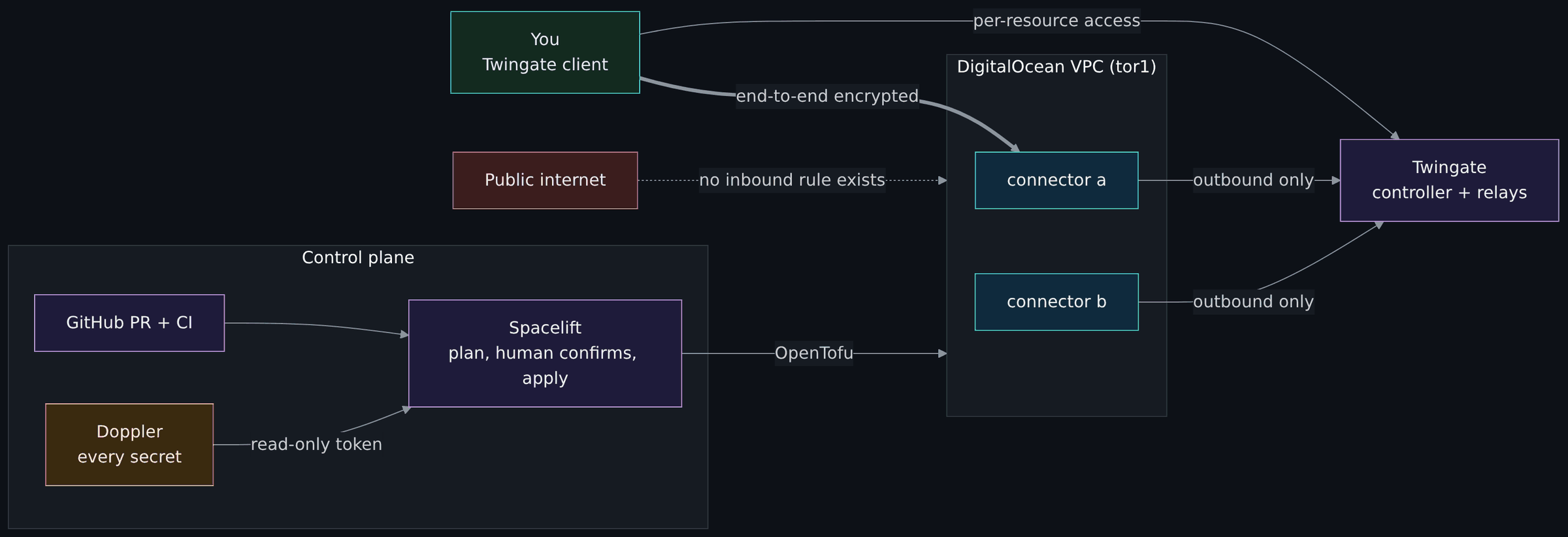
This is a reference environment on DigitalOcean using OpenTofu, Spacelift, Doppler, and Twingate. It builds a VPC where no droplets have public inbound ports, replacing traditional VPNs and bastion hosts with direct zero-trust access. The accompanying wiki contains step-by-step lessons, diagrams, and exercises designed to take a power user from local hardware to locked-down cloud infrastructure.

It is worth your time if you want to understand modern infrastructure-as-code and perimeterless networking without relying on enterprise budgets. However, it requires paying for your own cloud resources and assumes baseline technical literacy like git and basic networking. Skip it if you just want a quick click-ops deployment or a managed platform-as-a-service.

more: https://github.com/ChiefGyk3D/Clouds-Against-Humanity

my other side: ivo.blogspot.com


Peach: self-hosted media manager for adult collections

23 10 2026
Peach: self-hosted media manager for adult collections

Peach is an open-source, local-first application designed to organize adult video collections scattered across local disks and mounted cloud storage like 115, PikPak, or OneDrive. It combines a grid-based browser, metadata scrapers, and subtitle search into a single interface that runs on Windows, macOS, or Docker. The software reads existing NFO files and folder structures without modifying your original files while pulling in missing covers, tags, and creator updates from supported platforms.

It is worth a look if you are tired of manual sorting and want a unified local UI with browser extension integration for cloud downloads. The catch is that it remains an immature desktop tool with unsigned binaries, no official mobile app beyond web access, and requires you to bring your own cloud accounts and storage. Skip it if you just want a standard media server like Plex or Jellyfin for mainstream video.

more: https://github.com/peach-mitao/peach

my other side: ivo.blogspot.com


Doory: A self-hosted browser-based design editor

23 10 2026
Doory: A self-hosted browser-based design editor

Doory is a Dockerized, open-source design tool built on Django and FabricJS that replaces cloud-based options like Canva. It runs on your own hardware and handles everything from basic image cropping and PDF exports to animations, video generation, and real-time co-editing. The project also includes an optional Model Context Protocol server so AI assistants like Claude can directly generate and modify your designs.

It is worth setting up if you need an internal graphic editor without third-party data sharing, but the current template library is tiny at just ten starter items. You will have to seed your own fonts, icons, and templates before it is genuinely useful for a team. Skip it if you are looking for a drop-in replacement with a massive pre-existing asset library.

more: https://github.com/shaongitbd/doory

my other side: ivo.blogspot.com


Asap Karhutla 2026 dan Ujian Kredibilitas Regional Indonesia

22 10 2026
Asap Karhutla 2026 dan Ujian Kredibilitas Regional Indonesia

Sepanjang Agustus hingga September 2026, Greenpeace mencatat 5.540 titik api di 22 provinsi yang memicu kabut asap lintas negara ke Malaysia, Singapura, hingga Filipina. Lonjakan kasus ISPA di dalam negeri mencapai 277.075 kasus pada Oktober, sementara di Sarawak kasus asma melonjak 259 persen akibat buruknya kualitas udara.

Bencana berulang ini menunjukkan bahwa kegagalan mengendalikan kebakaran lahan bukan lagi isu domestik semata, melainkan beban diplomatik yang menguji kepemimpinan regional ASEAN. Ketika tekanan internasional meningkat, transparansi data dan komunikasi krisis yang terbuka seringkali menjadi ukuran utama tanggung jawab sebuah negara, meski sering diabaikan dalam penanganan teknis di lapangan.

more: https://theconversation.com/kredibilitas-indonesia-diuji-saat-bencana-dan-asap-karhutla-melintasi-batas-negara-294803

my other side: ivo.blogspot.com


The Cognitive Cost of Economic Downgrading

22 10 2026
The Cognitive Cost of Economic Downgrading

Financial pressure consumes finite mental capacity, leaving people with fewer cognitive resources for long-term planning and work. When economic hardship becomes collective, the social stigma of lowering one's living standards disappears, turning open compromises on daily expenses into a shared survival strategy. People selectively cut non-essential items first, protecting core aspects of their identity while negotiating cheaper ways to maintain small comforts.

The shift from outward displays of wealth to public acceptance of economic limits shows a pragmatic social adjustment, though the underlying mental fatigue remains a heavy burden. Societies can normalize austerity for a time, but treating structural economic pressure as an individual coping mechanism misses the root exhaustion. It is worth asking how long people can sustain this careful rationing before cognitive depletion takes a permanent toll on public well-being.

more: https://theconversation.com/downgrade-lifestyle-adaptasi-masyarakat-untuk-bertahan-hidup-294252

my other side: ivo.blogspot.com


Everyday intuition as a form of perception

22 10 2026
Everyday intuition as a form of perception

We tend to dismiss gut feelings as irrational heuristics, but ordinary intuition functions much like sensory perception by directly presenting facts with rational force. Just as seeing a car in the garage makes its presence immediately apparent, an instant aversion to a stranger or a suspicious email presents a conclusion without requiring an explicit chain of reasoning. This capacity operates continuously in daily life, bridging the gap between simple sensory awareness and abstract philosophical thought experiments.

Treating intuition as perceptual makes sense of why we can act reasonably on hunches we cannot yet articulate. At the same time, we still lack a clear account of when this mechanism misfires, meaning our immediate seemings require careful calibration against actual evidence. It is a useful framework for understanding the mind, but not an excuse to stop checking your work.

more: https://aeon.co/essays/sometimes-you-just-know-somethings-off-but-how

my other side: ivo.blogspot.com


Extend Agents CLI for LangChain and Custom Deploy Policies

22 10 2026
Extend Agents CLI for LangChain and Custom Deploy Policies

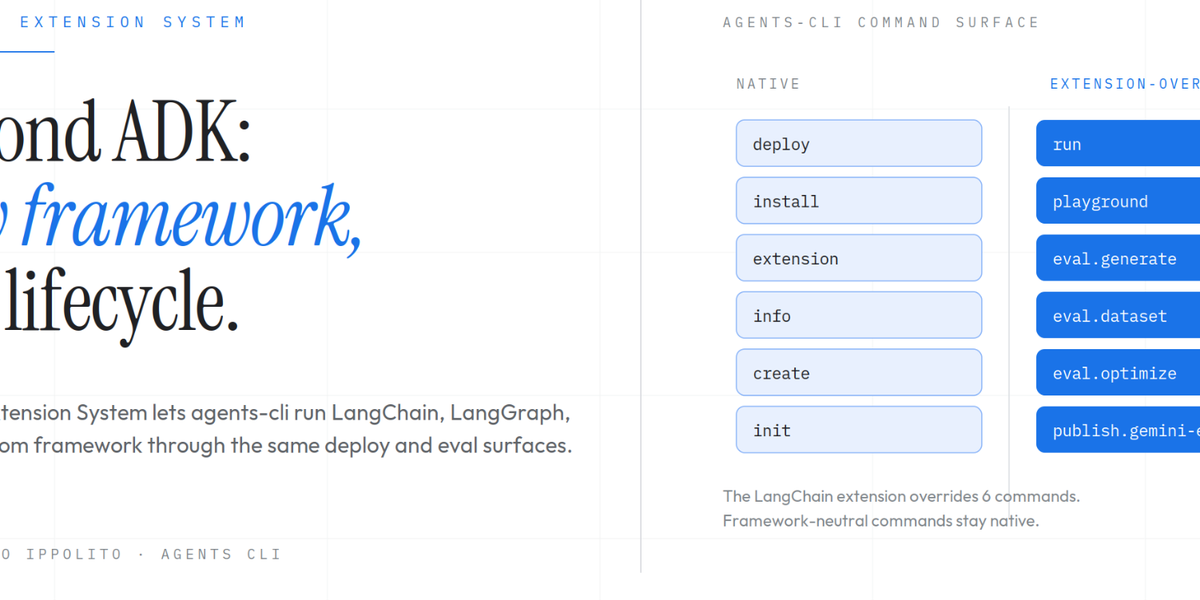
Google's Agents CLI, first launched at Cloud Next '26, now ships with an Extension System as of version 1.5.0. This allows developers to override existing commands or add new ones without forking the tool. Version 1.8.0 includes a first-party LangChain extension, enabling a full agent development lifecycle (scaffold, run, deploy, evaluate) with LangChain agents. It also facilitates custom policies, like an SBOM scan wrapping the deploy command.

This is a welcome evolution for agent development, especially for teams working across multiple frameworks or needing to enforce enterprise-specific governance. If you've been avoiding Agents CLI due to its initial ADK opinionation, this update makes it far more versatile. The limitation is that while the system is flexible, building complex custom extensions for unique policies will still require internal development effort.

more: https://developers.googleblog.com/powering-the-agent-development-lifecycle-with-any-framework-from-adk-to-langchain-and-beyond/


IBM Granite Time-Series Ensemble for Python

22 10 2026
IBM Granite Time-Series Ensemble for Python

IBM released granite-tsfm 0.3.11, a Python package that bundles four pre-trained time-series models into a single ensemble interface. Calling QuantileEnsembleForecaster.from_pretrained downloads the member checkpoints from Hugging Face and returns both point forecasts and quantile outputs without requiring prior training on your data. The default recipe pools forecasts in probability space using fixed equal weights.

It is worth testing if you need zero-shot probabilistic forecasting across mixed industrial or retail signals and want to skip the overhead of training model weights. The catch is that the first run takes extra time to download all four underlying architectures at runtime, and the package is not built for custom streaming pipelines. You should stick to a single tuned model if you already have clean data and well-defined domains.

more: https://huggingface.co/blog/ibm-research/granite-timeseries-ensemble-r1

my other side: ivo.blogspot.com