
Hypit lets coding agents generate video workflows

21 09 2026
Hypit lets coding agents generate video workflows

Hypit is a Node.js tool that extends CLI agents like Claude Code and Codex to create videos. It uses a script-based language where visual elements are anchored to spoken words, not timestamps. A drop-in video can be cloned into a reusable workflow, or agents can build new ones from templates and descriptions.

The tool itself is free, but you still pay for the AI models used for footage and images. It requires a capable coding agent and some configuration for API connections, making it less suitable for users who want a simple GUI without touching code.

more: https://github.com/hypit-ai/hypit

my other side: ivo.blogspot.com
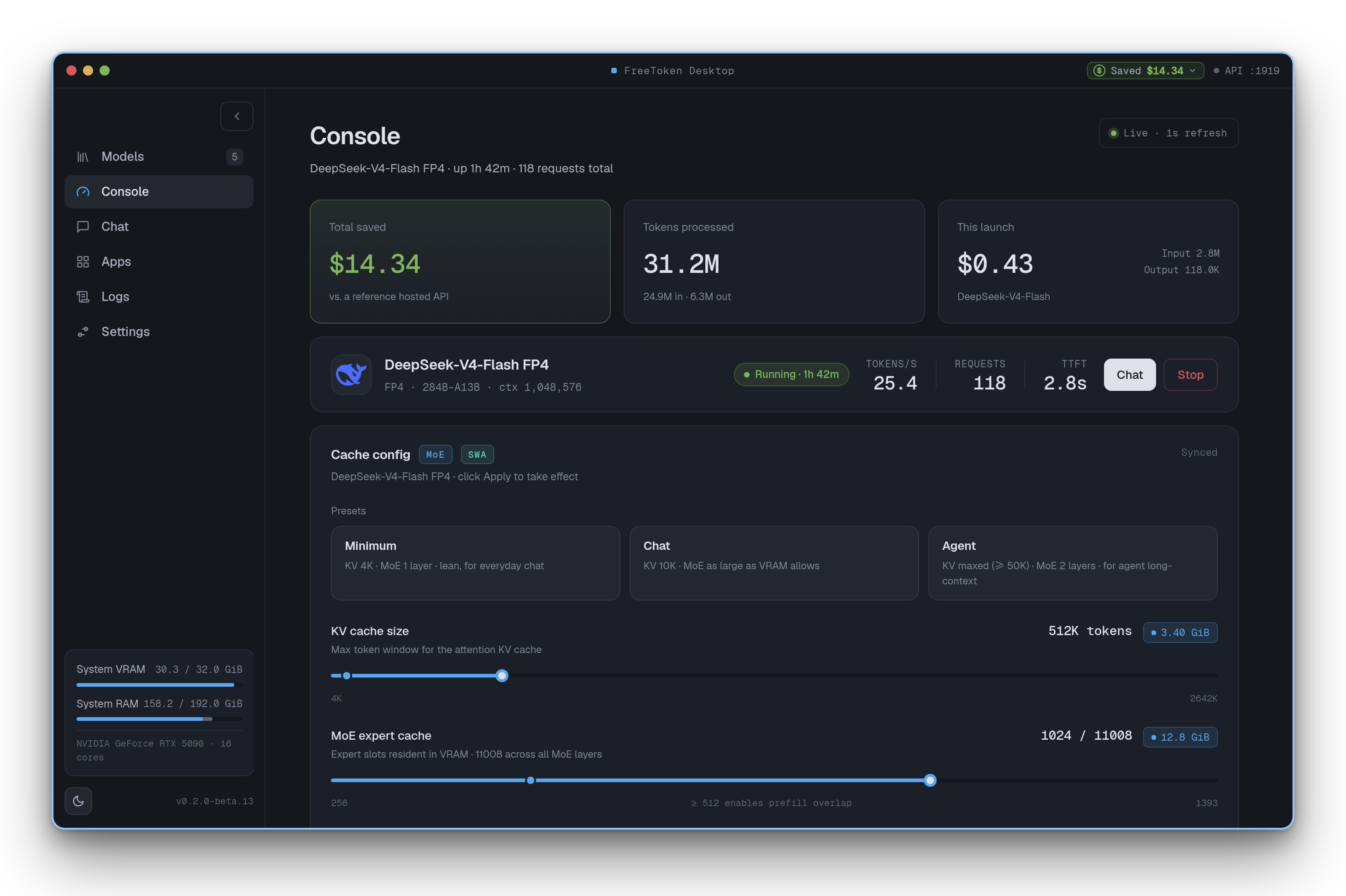


FreeToken runs 290B MoE models on consumer PCs

21 09 2026
FreeToken runs 290B MoE models on consumer PCs

FreeToken is an edge-native inference engine designed to serve frontier-scale Mixture-of-Experts models on personal hardware. It unifies GPU, CPU, and host memory into a single elastic platform to achieve interactive speeds for 290B+ parameter models. A desktop app is available for Windows and Linux to handle the initial setup and tuning.

It is worth a look if you have high-end consumer hardware and need local access to large MoE models without a datacenter cluster. The project is young and relies on a complex hardware abstraction, so expect some configuration friction. It is not a drop-in replacement for production-grade serving stacks like vLLM in a cloud environment.

more: https://github.com/FlashML-org/FreeToken

my other side: ivo.blogspot.com


Scaleway vs DigitalOcean

26 08 2019

Quote:

Benchmarks range wildly here, from Scaleway’s performance being “only somewhat worse than DigitalOcean” to “much worse” to “catastrophic”. 

Source:

https://blog.rebased.pl/2015/11/04/scaleway-vs-digitalocean.html

my other side: ivo.blogspot.com


Revert Microservices back to Monolith?

29 08 2018

This interesting article from DZone explores why in some cases microservices actually become a burden and reverting back to monolith instead can be the solution.

In early 2017, we reached a tipping point with a core piece of Segment’s product. It seemed as if we were falling from the microservices tree, hitting every branch on the way down. Instead of enabling us to move faster, the small team found themselves mired in exploding complexity. Essential benefits of this architecture became burdens. As our velocity plummeted, our defect rate exploded.

Eventually, the team found themselves unable to make headway, with 3 full-time engineers spending most of their time just keeping the system alive. Something had to change. This post is the story of how we took a step back and embraced an approach that aligned well with our product requirements and needs of the team.

Goodbye Microservices: From Hundreds of Problem Children to One Superstar

my other side: ivo.blogspot.com


Running Docker in Production?

25 01 2018

James Higginbotham describes nine things to consider when you decide to run docker in production servers.

Developers need to remember that Docker is a tool, not a full-blown cloud native architecture solution. It offers some amazing capabilities, and I’m very happy to have Docker as part of my architecture. But it requires the same effort to maintain a production Docker deployment as any other cloud-based solution (and perhaps even more).

Read more here.

my other side: ivo.blogspot.com


Jeff Cogswell is Comparing C++ Compilers

6 11 2013

Jeff Cogswell wrote an article in Slashdot “Speed Test: Comparing Intel C++, GNU C++, and LLVM Clang Compilers”.

He concluded:

It’s interesting that the code built with the g++ compiler performed the best in most cases, although the clang compiler proved to be the fastest in terms of compilation time. But I wasn’t able to test much regarding the parallel processing with clang, since its Cilk Plus extension aren’t quite ready, and the Threading Building Blocks team hasn’t ported it yet.

Read the full article here:

http://slashdot.org/topic/bi/speed-test-comparing-intel-c-gnu-c-and-llvm-clang-compilers/

my other side: ivo.blogspot.com


“ss -n” is faster than “netstat -na” on high load servers?

12 09 2013

# ss -n |grep ESTAB |wc -l
13615

# ss -n |grep CLOSE-WAIT |wc -l
10832

# ss -n |grep FIN-WAIT |wc -l
1976

# ss -V
ss utility, iproute2-ss061002

my other side: ivo.blogspot.com


C++ vs Java vs Python vs Ruby

1 02 2006

All about the comparison between C++, Java, Phyton and Ruby.

Here’s the link:

http://www.dmh2000.com/cjpr/index.shtml

my other side: ivo.blogspot.com