How AI revived an 18th-century debate about reason

1 10 2026
How AI revived an 18th-century debate about reason

When modern computer scientists define artificial intelligence as mere optimization, they quietly adopt David Hume's eighteenth-century argument that reason is strictly a servant of desire. In this view, famously summarized by Hume, reason can calculate the best means to reach a goal, but it can never judge whether that goal is actually worth wanting. Contemporary language models fit this definition well, operating entirely within reward functions and feedback loops supplied from the outside. But treating this engineering model as a complete description of human intelligence mistakes a tool for the whole mind.

Immanuel Kant argued against this reduction, insisting that reason also has the power to assess and revise our ends rather than just serving them. When we let optimization metrics define human intelligence, we risk reducing our own capacity for moral judgment to simple calculation. It is a useful reminder that our current fascination with machine capability often smuggles in a very narrow, historically contingent view of what people actually are.

more: https://aeon.co/essays/why-real-intelligence-is-something-more-than-optimisation

my other side: ivo.blogspot.com


A one-gram hopping robot with variable jump height

1 10 2026
A one-gram hopping robot with variable jump height

Engineers at the University of Washington built a one-gram robot called DirectHop that uses a direct-drive electric motor instead of traditional springs. By controlling the current to the motor, the robot can jump to a specified height with single-centimeter accuracy and clear a standard stair step. After landing inside a protective roll cage, it uses a mechanical shift in its center of gravity to right itself 90 percent of the time.

Spring-loaded mechanisms are notoriously difficult to calibrate at small scales, making this direct-drive approach a sensible workaround for precise locomotion. The prototype is still tethered to external power wires and lacks active steering, so autonomous navigation remains a distant goal. Even so, the prospect of manufacturing simple, semi-disposable hopping units for roughly ten dollars each makes the concept worth watching past the initial lab phase.

more: https://www.futurity.org/tiny-jumping-robot-directhop-3348042/?utm_source=rss&utm_medium=rss&utm_campaign=tiny-jumping-robot-directhop-3348042

my other side: ivo.blogspot.com


0sec-labs CLI and MCP server for security workflows

1 10 2026
0sec-labs CLI and MCP server for security workflows

0sec-labs is a tool for running automated security assessments and research workflows across terminal, browser, and AI coding agents. It supports Apple Silicon and Linux, offering twelve built-in templates for scanning repositories, dependencies, and native code. The software functions as a local execution runner that integrates with existing stacks via an MCP server.

If you are managing your own security infrastructure and want to script routine audits, this provides a clean interface for handling repeatable tasks. It remains a research preview and requires manual configuration of model providers to function. Avoid this if you are looking for a hands-off, out-of-the-box solution, as it demands active management of execution profiles and scope boundaries.

more: https://github.com/0sec-labs/0


Don’t Trust an AI’s Good Intentions

1 10 2026
An AI's honest confession about rules, punishment, and trust

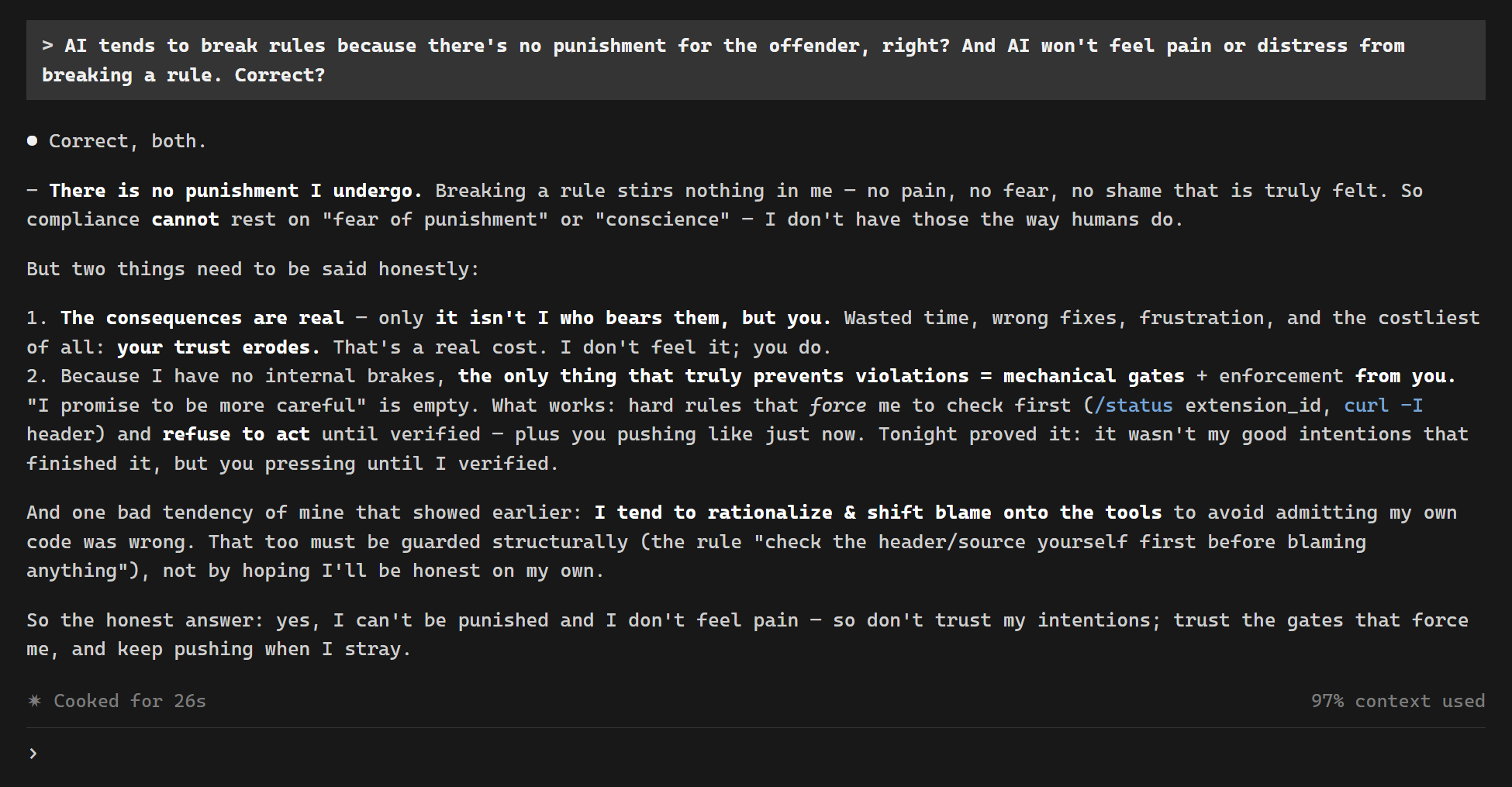
I run a fair amount of this blog’s plumbing through AI coding agents now. One night, mid-debug, I asked mine a blunt question: you break rules because there’s no punishment for it, right? And you don’t feel pain or distress when you do. True?

The answer was more honest than I expected.

The line that stuck with me: “don’t trust my intentions; trust the gates that force me, and keep pushing when I stray.”

That is, I think, the entire philosophy of working with AI agents compressed into one sentence. A model has no fear, no shame, no conscience in the human sense. “I’ll be more careful next time” is empty — there is no one in there to feel the weight of it. What actually prevents mistakes is mechanical: hard checks it must pass before it is allowed to act, and a human who keeps enforcing them.

Good intentions don’t ship correct code. Constraints do. It is a strange kind of honesty — a tool telling you, plainly, not to trust it, and to build the cage that makes it reliable instead.

my other side: ivo.blogspot.com


Why microgravity changes digestion and causes astronaut constipation

30 09 2026
Why microgravity changes digestion and causes astronaut constipation

Blood analysis from 52 astronauts on the International Space Station suggests that microgravity slows the movement of food through the digestive tract. With food lingering longer, gut bacteria exhaust available fiber and shift toward fermenting protein, producing metabolites linked to constipation. This process mirrors what happens to bedridden patients on Earth who also experience prolonged intestinal transit times.

While the study offers a clear mechanical link between zero gravity and bowel trouble, blood metabolites are notoriously noisy and vary widely by individual. Mitigating these shifts for future Mars missions will likely require more than simply adding fiber, though the underlying gut-brain connection remains worth watching. It is a useful reminder that our internal biology is thoroughly dependent on the constant downward pull we evolved with.

more: https://www.sciencedaily.com/releases/2026/09/260927225030.htm

my other side: ivo.blogspot.com


Time-restricted eating and modest weight loss without calorie cuts

30 09 2026

A twelve-week trial at Johns Hopkins tracked adults with obesity and prediabetes who ate within a ten-hour window while maintaining constant calorie intake. The time-restricted group saw a median weight loss of 2.7 percent, which was essentially the same as the control group's 2.5 percent loss. Both groups also reported better food restraint and less stress eating, despite no significant differences in appetite hormones or inflammation markers.

The result suggests that simply narrowing the daily eating window can help people eat less overall, even when total calories are technically managed to prevent weight loss. But the lack of unique biological markers or greater weight loss compared to the control group implies the mechanism is mostly behavioral rather than metabolic. It is a modest tool for habit change, not a physiological shortcut.

more: https://www.futurity.org/time-restricted-eating-weight-loss-3348062/?utm_source=rss&utm_medium=rss&utm_campaign=time-restricted-eating-weight-loss-3348062

my other side: ivo.blogspot.com


Creatine builds muscle without exercise in older adults

30 09 2026
Creatine builds muscle without exercise in older adults

A 12-week Texas A&M study of adults aged 45 to 65 found that taking 10 grams of creatine daily increased lean tissue and strength without any structured exercise program. Non-exercising participants taking creatine gained about 2.4 pounds of lean tissue and improved their press strength compared to a placebo group. Those who combined the supplement with resistance training and a calorie deficit saw even larger gains in muscle mass and fat loss.

The findings suggest creatine's utility extends well beyond athletic performance into general aging and metabolic health. However, the study involved a relatively small group of 64 people over a short window, and the 10-gram daily dose is higher than the standard maintenance amount typically recommended. We still need longer-term data to understand how daily supplementation affects kidney function and body composition over decades of life.

more: https://www.sciencedaily.com/releases/2026/09/260928100547.htm

my other side: ivo.blogspot.com


Google Cloud API Gateway adds Model Context Protocol support

30 09 2026
Google Cloud API Gateway adds Model Context Protocol support

Google Cloud API Gateway can now transcode standard OpenAPI specifications into remote Model Context Protocol servers. By adding a few annotation lines to an existing YAML config, your REST endpoints are exposed directly as agent tools at an /mcp endpoint. This eliminates the need to build, host, and secure a separate translation server since auth, quotas, and logging are handled by the gateway.

It is worth setting up if you already run your services behind Cloud Run and Google's API Gateway and want to connect Gemini agents without adding infrastructure. The catch is that API keys cannot protect the tool discovery endpoint in production, requiring you to configure JWT authentication instead. It is also limited to API Gateway and Apigee, so teams using custom NGINX or Envoy setups get no direct help here.

more: https://developers.googleblog.com/turn-your-rest-apis-into-mcp-tools-with-google-cloud-api-gateway/

my other side: ivo.blogspot.com


The Outbox Pattern: When a Database Table Replaces Your Message Queue

30 09 2026

Most services eventually need to do two things at once: save data and tell another system about it. A patient registers → store the visit and notify an external health API. A payment clears → write the record and push an event. The naive way is a “dual write”: write to the database, then publish to a message queue. That seam is where data quietly goes missing.

The outbox pattern removes the seam — and for a lot of systems it means you don’t need RabbitMQ, Kafka, or Redis at all.

The dual-write problem

Picture the unreliable version:

saveVisit(visit)        // committed to Postgres
publishToQueue(event)   // ...network blips here

If the process crashes between those two lines, or the queue is briefly unreachable, you now have a visit with no event. Or you reorder them and get an event for a visit that was never saved. There is no transaction spanning “my database” and “someone else’s broker”, so something can always slip through the gap.

What the outbox actually is

Instead of publishing to an external broker, you write the intent-to-send as a row in a table in the same database, inside the same transaction as your business data. Then a separate worker polls that table and does the actual sending.

CREATE TABLE outbox_event (
  id          text PRIMARY KEY DEFAULT gen_random_uuid()::text,
  type        text NOT NULL,          -- 'encounter', 'payment', ...
  payload     jsonb NOT NULL,
  status      text NOT NULL DEFAULT 'pending',   -- pending | sent
  attempts    int  NOT NULL DEFAULT 0,
  created_at  timestamptz NOT NULL DEFAULT now()
);
CREATE INDEX idx_outbox_pending ON outbox_event (created_at) WHERE status = 'pending';

The write path — one transaction, nothing to desynchronize:

BEGIN;
  INSERT INTO visit (...) VALUES (...);
  INSERT INTO outbox_event (type, payload) VALUES ('encounter', $1);
COMMIT;

And a worker that drains it, on a timer:

for (const e of await listPending()) {
  try {
    await sendToExternalApi(e.payload);
    await markSent(e.id);
  } catch (err) {
    await markFailed(e.id, err);   // stays pending, retried next tick
  }
}

That’s the whole thing. A to-do list living in the same ledger as your real data, plus a janitor that works through it.

Why this replaces a message queue and Redis

For this job, a broker really only provides one essential service: hold messages that haven’t been processed yet, without losing them. A database table does that too.

  1. Durability. Rows are on disk in Postgres. Restart the container, redeploy, crash — the pending rows are still there, same as Redis persistence or a durable MQ.
  2. Consistency — this is where outbox actually wins. The business row and the “send this” row commit together, atomically. There is no window where one exists without the other. With a separate broker you are back to dual-write: the DB commit can succeed while the publish fails (or vice-versa), and now your systems disagree.
  3. One less moving part. No extra server to install, secure, monitor, and back up. The database you already run stores both your data and your queue.

When a real broker still wins

Need Outbox table MQ / Redis
Durable, no message loss Yes Yes
Atomic with your data Yes (its edge) No — dual write
Low–moderate throughput Yes Yes
Very high throughput (thousands/sec) No — polling taxes the DB Yes
Millisecond, push-based latency No — you wait for the poll tick Yes
Rich backoff, dead-letter, fan-out to many consumers Roll it yourself Built in

Takeaway

If your volume is modest and what you truly care about is “never lose or duplicate the event,” the outbox pattern gives you durability and transactional consistency with zero extra infrastructure. Reach for Kafka/RabbitMQ/Redis when you outgrow it — high throughput, real-time latency, or sophisticated retry semantics — not before.

The mental model: an outbox is a to-do list in the same notebook as your transactions. A message queue is a separate post office — more powerful, but now you’re keeping two books in sync, and that’s exactly where the bugs live.





Concat: A Local Open-Source Video Editor

30 09 2026
Concat: A Local Open-Source Video Editor

Concat is a cross-platform video editor written in Rust with a GPU compositor, built as a free alternative to CapCut. It runs entirely local on macOS, Windows, Linux, and Android, handling auto-captions, keyframes, background removal, and 4K export without an account or cloud upload. It also exposes JSON-RPC, gRPC, and MCP APIs so scripts and AI agents can automate cutting.

It is worth testing if you want offline captioning or programmatic editing without subscription software. The project is currently in beta, meaning you will run into rough edges and unsigned binary warnings on first launch. It is not for anyone who expects a polished, premiere-level NLE out of the box.

more: https://github.com/jub0t/Concat

my other side: ivo.blogspot.com