Awesome Cloudflare Self-Hosted directory of serverless applications

26 09 2026

This repository lists open-source projects designed to run entirely within a Cloudflare account using Workers, D1, and R2. It covers replacements for common SaaS tools like analytics platforms, feedback boards, and link shorteners. Each entry is audited for its actual deployment configuration rather than its marketing claims.

The list is a useful resource if you want to eliminate monthly SaaS invoices and consolidate your infrastructure on Cloudflare’s edge. However, it is not for those who want portability, as these apps are tightly coupled to Cloudflare proprietary APIs and are difficult to migrate elsewhere.

more: https://github.com/theoephraim/awesome-cloudflare-selfhosted



Why aging muscles lose their nerve signals

25 09 2026
Why aging muscles lose their nerve signals

Age-related muscle weakness is typically blamed on vanishing muscle mass or dead motor neurons. Researchers at the University of Missouri found that the connection itself breaks down: declining levels of a protein called NaV1.4 prevent the neuromuscular junction from reliably passing electrical signals from nerve to muscle. In aging animal models, partially blocking a second protein, ClC-1, counteracted this deficit and restored muscle force.

Treating sarcopenia as an electrical transmission issue rather than simple tissue loss is a welcome shift in how we think about aging. Still, moving from rodent models to older humans is rarely straightforward, and clinical trials testing these specific inhibitors are currently focused on inherited neuromuscular disorders rather than general frailty. It points to a clear biological mechanism, but practical applications are still a long way off.

more: https://www.futurity.org/preserving-muscle-strength-3346362/?utm_source=rss&utm_medium=rss&utm_campaign=preserving-muscle-strength-3346362


Biological decision making uses quantum probability math

25 09 2026
Biological decision making uses quantum probability math

Researchers are finding that biological systems often process information using non-Boolean probability structures originally developed for quantum mechanics. Rather than relying on classical logic, these systems model decision-making through interference patterns and superposition-like states. This suggests that the mathematical framework of quantum physics is more useful for describing life than the physical properties of quantum particles themselves.

This shift moves the focus from hunting for delicate quantum states in warm biological environments to identifying how organisms effectively emulate quantum logic. While this provides a powerful new toolkit for modeling complex biological behavior, it remains a mathematical analogy rather than proof of a fundamental physical mechanism. Skepticism is warranted until we understand whether these patterns are universal features of life or merely convenient abstractions.

more: https://www.quantamagazine.org/biology-might-not-be-quantum-but-its-math-is-quantumlike-20260923/


A dead star producing an unexplained shock wave

25 09 2026
A dead star producing an unexplained shock wave

Astronomers have identified a bow shock around the white dwarf RXJ0528+2838 that defies standard stellar models. The system lacks the accretion disc typically required to drive such powerful outflows, yet it has been venting material for at least 1,000 years. Observations suggest the star's magnetic field plays a role in channeling matter, but the energy source remains unidentified.

This discovery forces a reconsideration of how binary systems exchange mass and energy without traditional discs. Current magnetic field theories fail to account for the duration of the phenomenon, leaving the underlying mechanism a mystery. Future observations with larger telescopes will be necessary to determine if this is an outlier or evidence of a broader, misunderstood process.

more: https://www.sciencedaily.com/releases/2026/09/260924020410.htm


Jia-Ethan codex-keysmith CLI deployment and rollback tool

25 09 2026
Jia-Ethan codex-keysmith CLI deployment and rollback tool

codex-keysmith is a Python 3.10+ command-line utility that manages instruction injection for local Codex instances on macOS and Linux. It runs via a single signed release script or git checkout, letting you preview configuration plans with dry-run flags before writing to disk. The tool modifies only downstream session behavior without reading account credentials or altering the core client binary.

If you manage multiple local AI coding agents and want reproducible, auditable system prompts without manual file edits, it is worth a look. However, Windows support remains experimental and unverified, and macOS users will trip over Gatekeeper due to unsigned binaries. Skip it if you prefer managing environment variables and configuration files by hand.

more: https://github.com/Jia-Ethan/codex-keysmith


Octop: Self-Hosted Multi-Agent AI Assistant

25 09 2026
Octop: Self-Hosted Multi-Agent AI Assistant

Octop is an open-source, self-hosted Python application that runs a multi-agent AI assistant platform locally. A single process handles the FastAPI backend, SQLite database, React dashboard, and integrations with Telegram, DingTalk, and other messaging apps. It supports RAG, browser automation via headless Chromium, and IDE workflows through the agent-client-protocol.

It is worth setting up if you want to centralize private chat logs and scheduled tasks on your own hardware without relying on third-party SaaS wrappers. However, managing the configuration, security guardrails, and multiple agent profiles requires patience and a tolerance for early-stage Python tooling. Skip it if you just want a standard single-user chat interface.

more: https://github.com/TencentCloud/Octop


AIPOCH Open-Science: Local AI Research Workbench

25 09 2026
AIPOCH Open-Science: Local AI Research Workbench

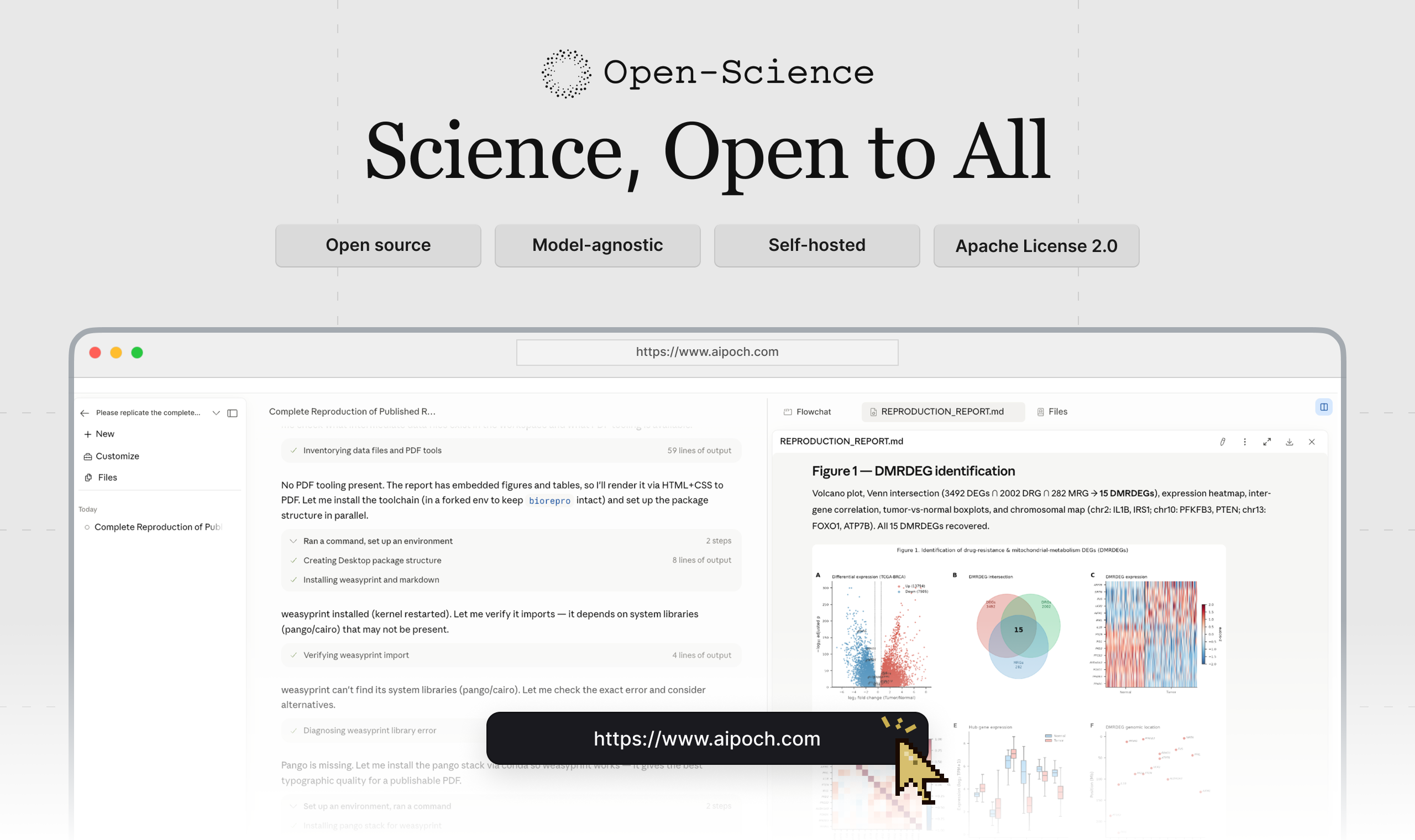
AIPOCH Open-Science is a local-first, model-agnostic desktop application for running reproducible research tasks via AI agents. Released at version 0.33.2 with cross-platform support for macOS, Windows, and Linux, it coordinates Python and R execution, literature search, data connectors, and file generation within a single project workspace. It functions essentially as an orchestrator for local or API-backed LLMs to automate data-intensive analysis while maintaining traceable provenance.

If you routinely juggle scripts, data tables, and literature notes across different notebooks, this workbench saves significant friction by keeping the execution loop contained locally. However, it is not built for teams wanting collaborative cloud whiteboards or anyone unwilling to vet agentic code output before it runs on their filesystem. Expect to spend real time configuring your local runtimes and API keys during the initial setup wizard.

more: https://github.com/aipoch/open-science


GenOffice: Open Source AI Office Suite

25 09 2026
GenOffice: Open Source AI Office Suite

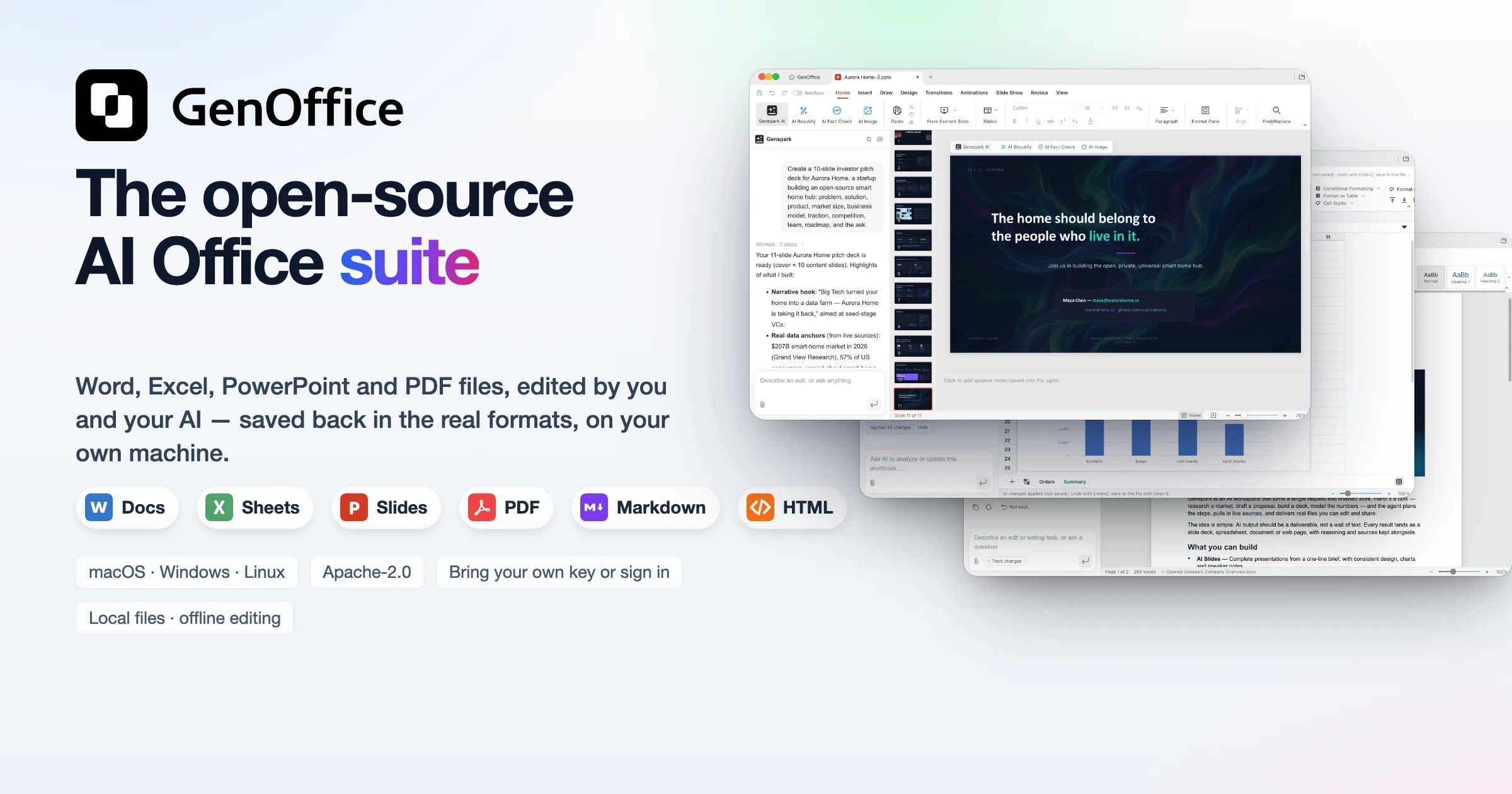
GenOffice is a cross-platform desktop application and CLI that edits native docx, xlsx, pptx, and pdf files using local or cloud AI models. It preserves the underlying file structures byte-for-byte while allowing an integrated agent to write formulas, generate slides, and modify documents with tracked changes. The project includes a local SQLite text search and supports custom API keys for major providers alongside a free tier.

It is worth testing if you routinely script document generation or want an agent that can interact directly with office formats on your local machine. The catch is that while the file handling is local, the heavy lifting depends on external LLM calls and API costs can add up quickly. If you do not use coding agents or AI assistance in your document workflow, standard office suites remain simpler.

more: https://github.com/genspark-ai/genoffice


DSCODE: A Terminal Coding Agent for macOS

25 09 2026
DSCODE: A Terminal Coding Agent for macOS

DSCODE is a terminal-based coding agent for macOS built on DeepSeek Harness. It uses a persistent shell to run tests and edit files while allowing multiple local sessions to share the same runtime and communicate directly. You can script non-interactive turns, run background side-tasks in read-only child sessions, and delegate work between agents using a shared mailbox.

It is worth a look if you already rely on DeepSeek and want multi-agent workflows running locally in your terminal rather than in a cloud IDE. However, it is strictly tied to macOS and requires trusting its automated review model to handle permissions and diff checks. Skip it if you use Linux or prefer a traditional single-agent setup.

more: https://github.com/qiz029/dscode


Stop That Shit Blocks AI Agent Scope Creep

25 09 2026
Stop That Shit Blocks AI Agent Scope Creep

This is a plugin for Codex and Claude Code that enforces strict boundaries on AI task execution. It intercepts tool calls to prevent unauthorized file writes, unnecessary dependency additions, and redundant verification loops. The system runs on Node 18+ and uses a specific skill and guard architecture to halt actions that violate the defined intent.

It is useful if you are tired of agents refactoring code they were not asked to touch or generating useless checksums. The catch is that it requires manual configuration for specific file or dependency allowances, which adds friction to complex tasks. This is not for teams that prefer fully autonomous agent behavior without hard stops.

more: https://github.com/lennney/stop-that-shit